
Border Patrol, Out-Of-State Police Illegally Searched Elmwood Park License Plate Camera Data

By Kevin Gosztola, Editor
In the months leading up to the deployment of ICE and other federal agents in the Chicagoland area, the United States Border Patrol searched data collected by Elmwood Park’s network of license plate reader cameras thousands of times.
Additionally, officers from several police departments, primarily in southern states, conducted searches on behalf of ICE that included data from the Elmwood Park license plate reader cameras.
On September 6, 2025, federal agents arrived in the Chicagoland area as part of Operation Midway Blitz. Nearly 3,800 immigrants, according to Injustice Watch, were detained during the campaign.
Secretary of State Alexi Giannoulias oversaw an audit in June and then ordered Flock to shut off Border Patrol access to all license plate reader cameras in Illinois. Giannoulias said the searches violated a state law that was passed two years ago, which was intended to prevent police agencies outside of Illinois from accessing data related to immigration and reproductive health care.
By August, Flock revoked the Border Patrol’s access to nationwide license plate reader data.
More than 5,000 police agencies in the country have agreements with Flock. The company operated pilot programs with the Department of Homeland Security’s Customs and Border Protection and Homeland Security Investigations until the company faced a backlash.
The Elmwood Park Advocate obtained Flock network audit logs through the Freedom of Information Act (FOIA) that showed searches of license plate reader data by users outside of the Elmwood Park Police Department.
Border Patrol searched Elmwood Park license plate reader data 698 times in June 2025. By July 2025, that number more than doubled to 1516 searches, and in August 2025, the Border Patrol searched the data 862 times.
Additionally, audit logs showed that police departments in Alabama, Arkansas, Colorado, Florida, Georgia, Kansas, North Carolina, South Carolina, Texas, and Virginia conducted searches for ICE. Search results included data from Elmwood Park.
The reason for these searches was noted: ICE, “ICE Operation,” “ICE pick up,” “ICE Investigation,” “ice support,” “ice warrant,” “FUGOPS” [fugitive operations], “Ice Breaker,” or “ICE STORM.”
Several of the entries listed “ERO” as a reason, which stands for enforcement and removal operation.
The Elmwood Park Advocate asked Elmwood Park Police Chief Andrew Hock about the searches. He said the police department has control over “which agencies can access data.”
Hock added, “The Elmwood Park Police Department does not share its license plate reader data with Federal Agencies, including Border Patrol.” [Hock underlined not.] He mentioned that the police take their “obligations under the TRUST Act seriously.”
The TRUST Act generally prohibits police in Illinois from participating in federal immigration enforcement, especially by detaining someone at the request of ICE. But from May to August, Flock allowed the Border Patrol to search data collected by the cameras.
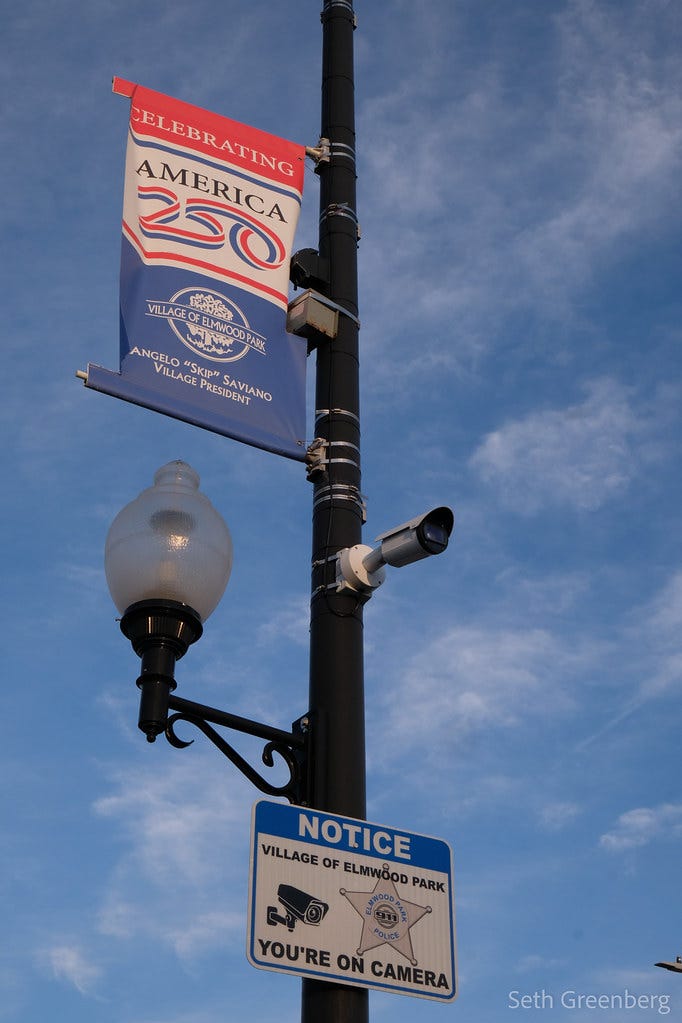
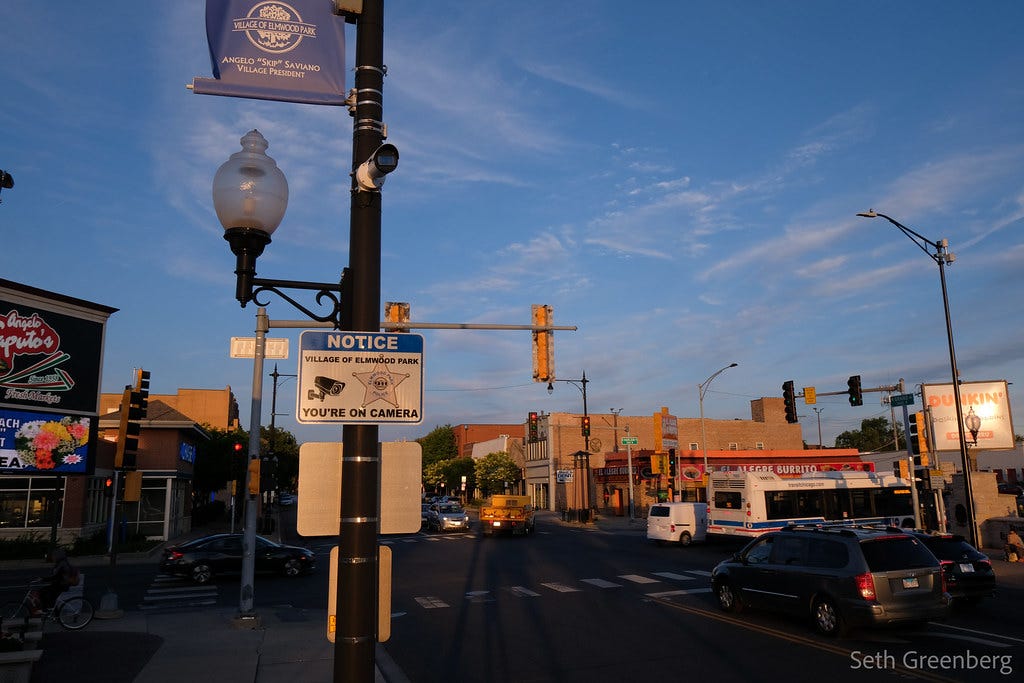
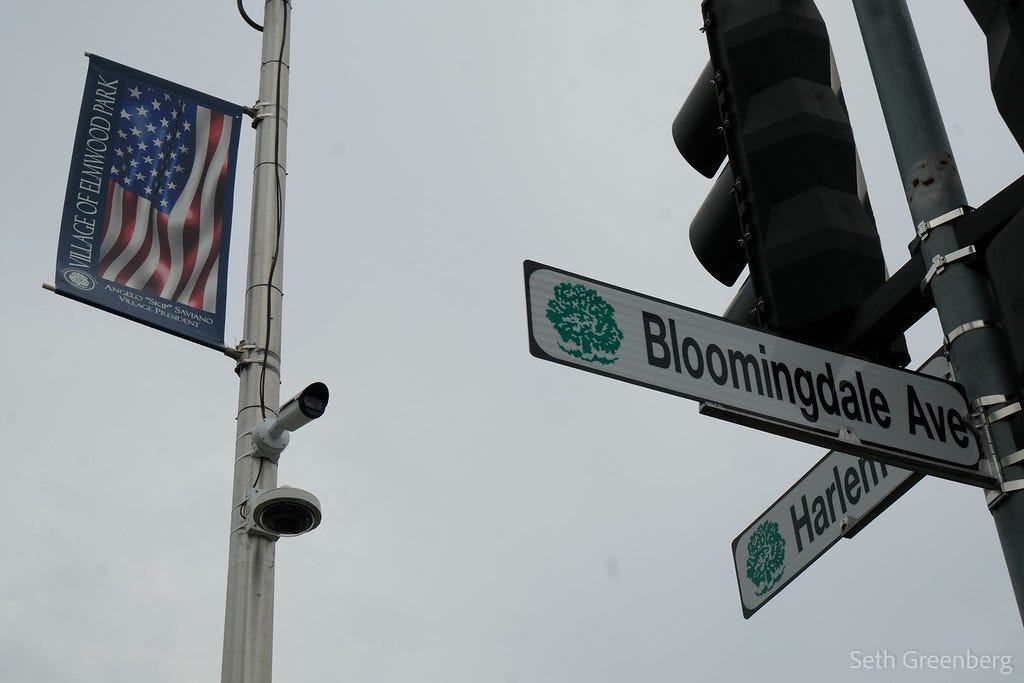
Elmwood Park has 11 license plate reader cameras that are linked into the Flock platform:
Two at Harlem Avenue and Grand Avenue.
Two at Harlem Avenue and North Avenue.
One camera at North Avenue and 75th Avenue
One camera at North Avenue and 76th Avenue
Five cameras at various intersections on Harlem Avenue
According to a Flock order form from June 2023, the village uses their own cameras. An email from a “regional success manager” sent on July 8, 2025, indicates that the village spends about $13,740 annually.
Giannoulias’ office found that “Flock did not have proper safeguards in place for data sharing, which was compounded by the fact that the company was running a pilot program with U.S. Customs and Border Protection, which Flock leadership was unaware of,” according to a press release from August 25, 2025. “This was uncovered as part of the Secretary of State’s audit.”
Hock asserted that Elmwood Park “limits data sharing to Illinois Law Enforcement agencies only.” [Hock underlined “Illinois Law Enforcement agencies only.”] However, logs of searches by out-of-state police agencies conflict with this statement.
The Elmwood Park Advocate showed Hock the searches out-of-state police, but Hock did not provide further comment.
All of the searches were possible as a result of Flock’s pilot program. As 404 Media reported in August 2025, “Customs and Border Protection (CBP) regularly searched more than 80,000 Flock automated license plate reader (ALPR) cameras” in the country.
Essentially, the pilot programs enabled ICE and Border Patrol to access data on potential targets for deportation without having to secure a search warrant.
Flock CEO Garrett Langley admitted in a press statement on August 25, 2025, that the company had not created “distinct permissions and protocols in the Flock system to ensure local compliance [with the law] for federal agency users.”
Going forward, Langley added, “All federal customers [would] be designated within Flock as a distinct ‘Federal’ user category in the system. This distinction [would] give local agencies better information to determine their sharing settings.”
Flock’s master services agreement with the village, which was signed on January 26, 2022, says that the company “shall not sell Agency Data or Aggregated Data.” But the DHS pilots apparently involved no written contracts, and that allowed Flock to take advantage of a loophole in many of its agreements with governments.
Police in Mount Prospect, Illinois, sparked an investigation into license plate reader use after they shared information with Texas police, who were searching for a woman who sought reproductive health care services. Mount Prospect license plate reader data had also been searched hundreds of times for immigration purposes.
In a statement post on June 12, 2025, the Mount Prospect Police Department addressed the misuse of license plate reader data. The department mentioned that data had been “accessed through the Flock Safety ‘National Lookup’ feature by other law enforcement agencies for purposes of immigration enforcement.
“The use of ALPR data collected by Mount Prospect Flock Safety cameras for this purpose does not align with the Mount Prospect Police Department’s values and is a clear violation of Illinois state law,” the police department added.
Hock was asked by the Elmwood Park Advocate if the Elmwood Park Police Department had opted into the “National Lookup” feature, since that is most likely how agencies throughout the U.S. would gain access to the data. But Hock declined to answer this question.
Additionally, it is unclear if village police took any steps to identify whether Elmwood Park license plate reader data had been misused by any agencies.
On May 6, 2025, a group of researchers obtained network audit logs from Danville, Illinois, through a FOIA request. The data was similar to the logs that the Elmwood Park Advocate obtained in January and April. (Danville is a town of around 29,000 people in the east central part of Illinois near the Indiana state line.)
404 Media reported on the logs, which showed “more than 4,000 nation and statewide lookups by local and state police done either at the behest of the federal government or as an ‘informal’ favor to federal law enforcement, or with a potential immigration focus.” But sometimes the searches were “informal,” and multiple police departments in Illinois apparently claimed that one or more searches were incorrectly labeled as being for an “immigration” reason.
“The fact that police almost never get a warrant to perform a Flock search means that there is not as much oversight into its use, which leads to local police either formally or informally helping the feds by doing lookups,” 404 Media noted.
Numerous Illinois towns took up the issue of license plate reader cameras after the secretary of state took action. Last August, Evanston announced that it was deactivating its license plate reader camera network and terminating their agreement with Flock.
“The findings of the Illinois Secretary of State’s audit, combined with Flock’s admission that it failed to establish distinct permissions and protocols to ensure local compliance while running a pilot program with federal users, are deeply troubling,” the city of Evanston declared.
Oak Park took similar action, and according to the Wednesday Journal, the village’s board of trustees opted to cancel the contract rather than only shut off the cameras for 90 days.
The trustees in Oak Park who voted to terminate business with Flock did so because of “concerns over privacy, distrust of the Flock corporation and the potential for the cameras to be used for immigration enforcement in violation of both state law and village sanctuary ordinances.”
Oak Park Trustee Jenna Leving Jacobson was worried that Flock would keep using Oak Park residents’ data “to build their databases, to train their AI” if they did not cancel the contract. “We can’t protect the data that’s being collected in our community from being used to harm innocent people, and we’re challenged to protect those people.”
While Arlington Heights renewed its contract with Flock in March, the town became the first in Illinois to establish fines for “unauthorized sharing” of data.
ICE operations in the Chicagoland area dropped significantly toward the end of 2025. But since June of this year, there has been an uptick in reports of people being detained by federal agents.
*For documents and further background on this reporting from the Elmwood Park Advocate, go here.