


By Kevin Gosztola, Editor
These days fewer and fewer Cook County judicial races are contested, and if a judge is elected to an open seat, they do not have to campaign against a challenger in the next general election. Instead, judges run for “retention,” and it is rare for a judge to lose their seat.
Which is why voters in the 11th judicial subcircuit have an important and unique opportunity. Residents in the subcircuit actually have a choice between two Democratic candidates in the March 17 primary. (Early voting begins on March 2.)
The 11th judicial subcircuit covers Edison Park, Elmwood Park, Galewood, Harwood Heights, Oak Park, and Rosemont.
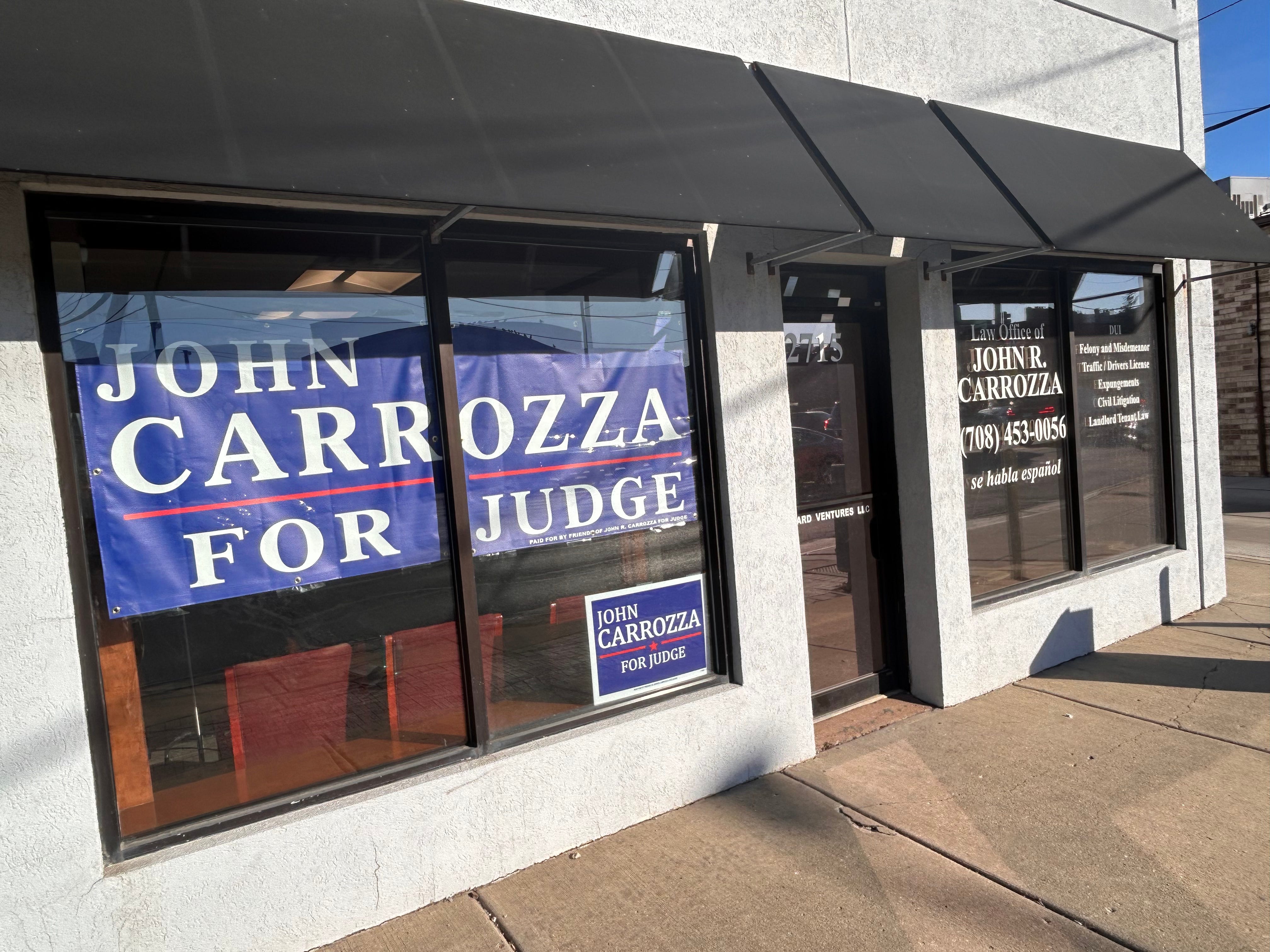
John Carrozza is a 46-year resident of Elmwood Park. For over 20 years, he has worked as a criminal defense attorney. His law office is in River Grove. Jarrett Knox has lived in Oak Park for over 15 years. He is a Cook County assistant state’s attorney in the child protection division.
Both Carrozza and Knox have financed a sizable portion of their campaigns with their own money. Carrozza and his law firm donated a total of $21,000 to his campaign committee. Knox donated a little more than $11,500 to his campaign committee.
Knox has obtained more endorsements than Carrozza, and the endorsements include Franklin Park Mayor and Leyden Township Democratic Committeeman Barrett Pedersen, State Senate President Don Harmon, Oak Park Village President Vicki Scaman, the Leyden Township Democratic Party, and the Democratic slating committee for the 11th judicial subcircuit.
Three Chicago aldermen, Jim Gardiner, Anthony Napolitano, and Nick Sposato, endorsed Carrozza, as well as Elmwood Park Village President Angelo “Skip” Saviano endorsed Carrozza. All four endorsements are noteworthy in a Democratic race, given the fact that Gardiner, Napolitano, Sposato, and Saviano each have histories as Republicans.
Chicago Firefighters Union Local 2 endorsed Carrozza while Plumbers Local 130 endorsed Knox.
The Elmwood Park Advocate sat down with Carrozza and Knox and interviewed them ahead of the primary.
Carrozza told the Elmwood Park Advocate that he had thought about running for an open judge position for a “long time,” but what pushed him to make the decision was the fact that he felt his “reach could be a lot larger to people” if he was “behind the bench as opposed to being behind this desk.”
He believes that he is the candidate voters should choose because his business has been in the subcircuit for the last 18 years—and he has a “very strong client base.”
“I have a really unique perspective. People come in these doors at some of the worst points of their lives,” Carrozza declared. “And even in a civil setting, [they say] I’ve never been sued before, and they don’t know what to do.” Carrozza contends that he has developed the temperament necessary to help them.
Similarly, Knox shared his experience working on child abuse and neglect cases. “People are coming to court at literally the worst moments of their lives. Kids have been removed from their home.
“Something really awful has happened, and people really feel like I’m losing my family,” Knox added. “It makes a huge difference to have a judge and a judiciary that is cognizant of that.”
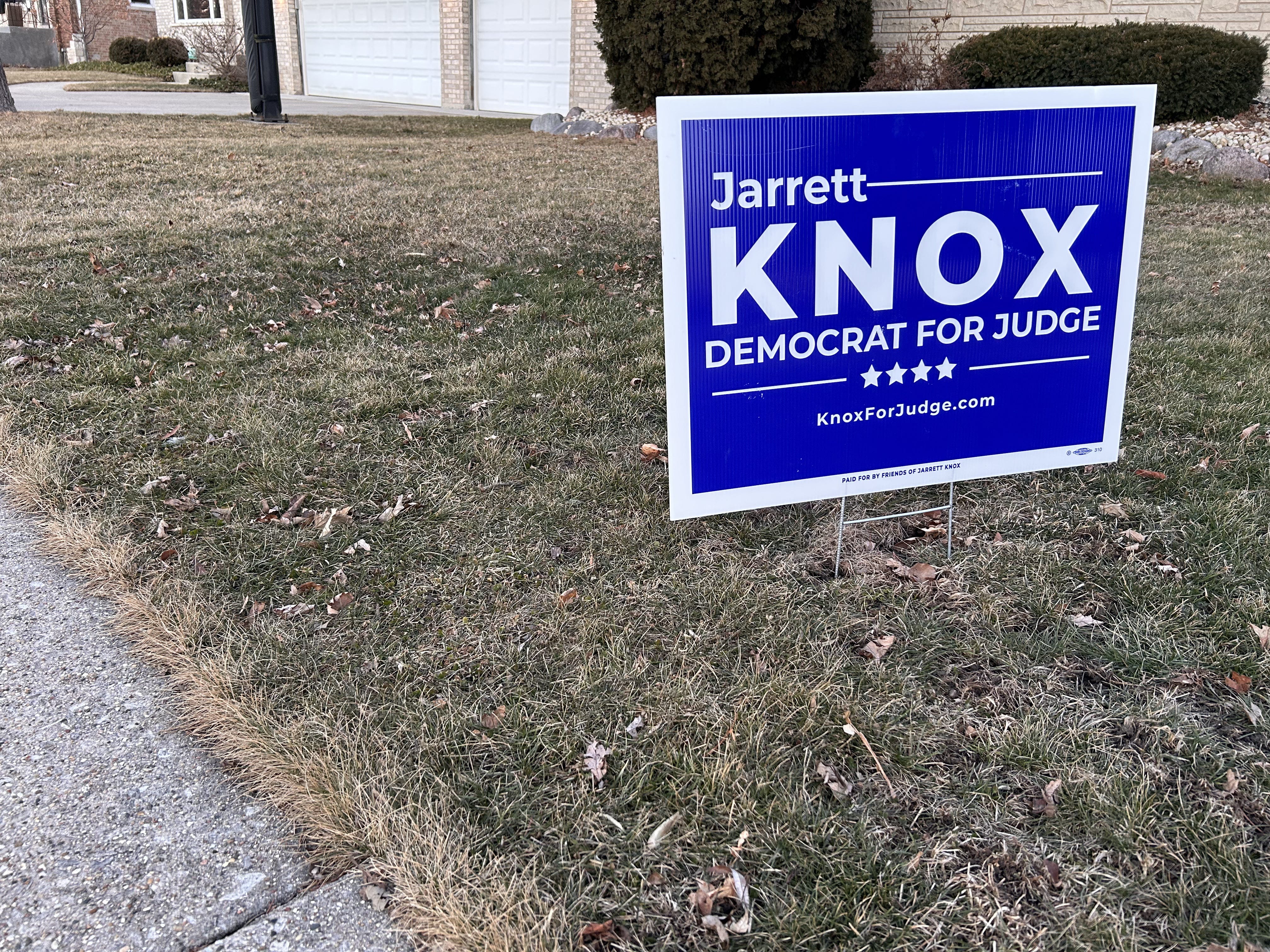
Knox and his wife have been licensed foster parents with the Hephzibah Children’s Association in Oak Park for more than 15 years. This has taught Knox to appreciate the “vulnerable human moment that’s happening in court,” whether that be in divorce cases, criminal cases, bankruptcy cases, or other cases where individuals deserve to be treated with “dignity and respect.”
According to Knox, his career as an attorney began in the “legal aid world” providing “free legal services for people who needed representation.” This work involved domestic violence survivors or seeking orders of protection for domestic violence survivors.
Carrozza pursued a career in criminal defense because this was the “arena” that would allow him to maximize his time in the courtroom. “That is a lost art, being able to put a trial on, being able to be in front of people to advocate for your clients, advocate for people who maybe don’t have funds,” and who “really, really, need the help.”
Asked about expanding remote access to hearings for defendants, Carrozza said Zoom is underutilized in a lot of courts.
“People have a hard enough time when they get in the system to get to and from court. Public transportation is not easy. They’re already behind the 8-ball a lot of times with regard to their job. Now you’ve got to take off work,” Carrozza argued. “Child care sometimes is hard. Now you’re expecting these people especially if they have multiple court appearances.”
Carrozza continued, “A lot of my clients they don’t have a license. They can’t drive. There are a lot of instances in which I drive them to and from court cause otherwise they’re not going to appear or they might not be able to appear.”
On the issue of access to the justice system in Cook County, Knox recalled working with families during the COVID-19 pandemic who were able to participate remotely in court proceedings. He sees remote access as crucial, too.
Knox said a child could have several parents, or there may be many persons in a sibling group’s family. “And those people can be in many different places. Or incarcerated or incarcerated out of state, or just living out of state. Or employed in a way that doesn’t lend to them being able to take time off work to come to court,” Knox added.
“So for people to be able to participate out of state, or not have to take a whole day off of work, is huge.”
In September 2023, the Pretrial Fairness Act went into effect. No longer is someone jailed before trial solely because they cannot afford to pay their bond.
Knox singled out the passage of this law as one of many “important strides” that Cook County has made in “addressing the ways our legal system has unfairly advantaged those with money and resources.”
“Making people’s incarceration status contingent upon their income or ability to pay is problematic,” Knox told the Elmwood Park Advocate.
Carrozza largely agrees with Knox, however, he insisted that judges no longer have enough discretion to make decisions about the conditions for release. “You only have two options now—detain or not detain. Where before I would have been able to look at the entire scope of that person, whether that be a background, whether they have a job, whether they have children, whether they can afford a bond, and be able to make an informed decision.”
According to the Civic Federation, a nonpartisan government research organization committed to public policy research on Chicago and Illinois, judges still have the ability to set conditions of release if a defendant is not detained. They may “consider the nature and circumstances of the offense charged, the weight of the evidence against the defendant, the defendant’s history and characteristics and the risks that would be posed by the defendant’s release.”
Both Carrozza and Knox agreed that they should be mindful of donations accepted by their campaign committees in order to avoid the appearance of conflicts of interest.
Carrozza has raised around twice as much money as Knox. Gerard Ventures, a property management company, provided a $14,000 loan to Carrozza. Advantage Futures, a futures trading merchant in Chicago, donated $3,000. Drill Rod & Tool Steels, Inc. donated $2,000. The Illinois Municipal Police Association donated $1,000.
Multiple individuals donated $1,000 or more to Knox’s campaign committee, but none of those donations have come from any companies or associations.
One of the few criticisms of Carrozza appeared in a candidate profile compiled by Injustice Watch, a Chicago-based nonprofit journalism organization that promotes equality and justice in the court system. The profile informed potential voters that he is a fourth-degree member of the Knights of Columbus, which is a “nearly 150-year-old, male-only Catholic fraternity and service organization whose leaders have historically opposed abortion rights and same-sex marriage.”
Carrozza does not oppose same-sex marriage, but apparently, he is opposed to abortion on “religious grounds.” He said, “I do truly believe that my beliefs—whatever they may be—would not come into play with regards to any type of rulings.”
Asked by the Elmwood Park Advocate about this criticism, Carrozza declined to comment on the Knights’ history of influence in United States politics. He insisted that he is only involved in the organization to help with the “food pantry, which feeds somewhere in the range of 100 families a month.”
Carrozza also chairs an annual “Tootsie Roll Drive” that is the third weekend of September. Funds raised go to “children and adults with intellectual disabilities.”
Knox is endorsed by Personal PAC, an organization committed to defending abortion rights and access in Illinois. He said, “There are so many things that we consider fundamental rights that have hung in the balance,” and in Illinois, “If you look at the case law where the [state] supreme court found that a woman’s right to abortion access is tied up in the due process clause, a lot of that is because the U.S. Supreme Court found that a woman’s privacy rights are in the due process clause.”
The U.S. Supreme Court no longer recognizes a woman’s right to choose, and so Knox acknowledged that a circuit court judge could be asked to decide a case that involved the “fundamental right” to reproductive healthcare.
Anyone driving around Elmwood Park will see numerous signs for Carrozza. He attributes the success of his voter outreach to the fact that he spends “countless hours” each day walking and meeting as many people as possible.
“Most of my day is spent running the business, my law office, and then come second half of the day, [I’m] out knocking doors, meeting as many people as I can, and then honestly [I’m] back here at my law office working through most of the night to get prepared for the next day.”
While Knox has been in the courtroom for child abuse and domestic violence cases, he’s only handled one criminal case that involved a misdemeanor. Carrozza strongly believes that voters should choose his 20 years of experience over Knox’s lack of experience with criminal cases.
“My office is littered with case after case after case, and we handle everything from minor traffic stuff all the way up to Class X felonies,” Carrozza declared.
“I think that gives me a really big leg up,” Carrozza continued. “I am not going to be a person who needs to have any on the job training. I will be ready day one to be behind the bench.”
Finally, the Elmwood Park Advocate asked Carrozza and Knox to comment on the “dwindling competition in Cook County judicial primary races.”
Knox did not fault anyone for not stepping forward to run for office. “Something needs to change. I do think that it is important that voters are given a choice, and that voters have some say in this [race] in a way that they meaningfully don’t in many of these races.”
“These used to be always contested,” Carrozza said. But now, “People are dissuaded if they’re not backed by the [Democratic Party]. Money is always an issue.” Also, “No one wants to be attacked either, and I think that is a big turn off for people.”
Turnout is often pretty low in primary elections during a midterm year. But if 2026 is a repeat of 2022, voters who turn out will not neglect the judicial race between Carrozza and Knox.
Excellent article and very informative. Thanks for the info.
Judges are always the difficult ones to look Into and really can hurt or help allot.