

“Stories of Our Bungalows” celebrates the history, character, and craftsmanship of Elmwood Park’s iconic homes while encouraging neighbors to preserve their timeless beauty for generations to come.
By Sara Lindsay, Deputy Editor
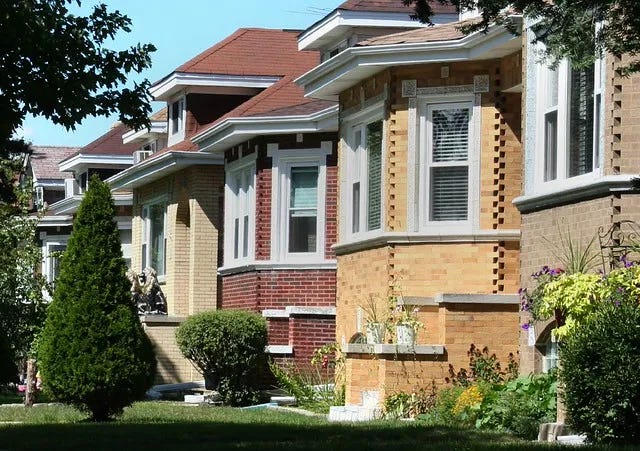
Anyone who has lived or visited Elmwood Park’s north side has noticed that almost every home looks like a variation of the one next to it—the same low roofs, the same textured brick, and the same eight steps up to the front door.
These homes are specifically known as the John Mills bungalows.
In the early 1900s, Chicago was in the middle of a housing boom and tens of thousands of brick bungalows were being built across the city. They were marketed as the perfect middle class home—fire-safe, affordable, modern, and solidly built.
This wave of construction created what is now known as Chicago’s Bungalow Belt, a wide ring of neighborhoods built largely between 1910 and 1940 that wraps around the city and extends into nearby suburbs.
John Mills bungalows are one of the most concentrated and distinctive examples of that movement just outside the city.
At the time, Elmwood Park was still mostly farmland, but its proximity to the city and its access to commuter trains made it an appealing spot to build a community.
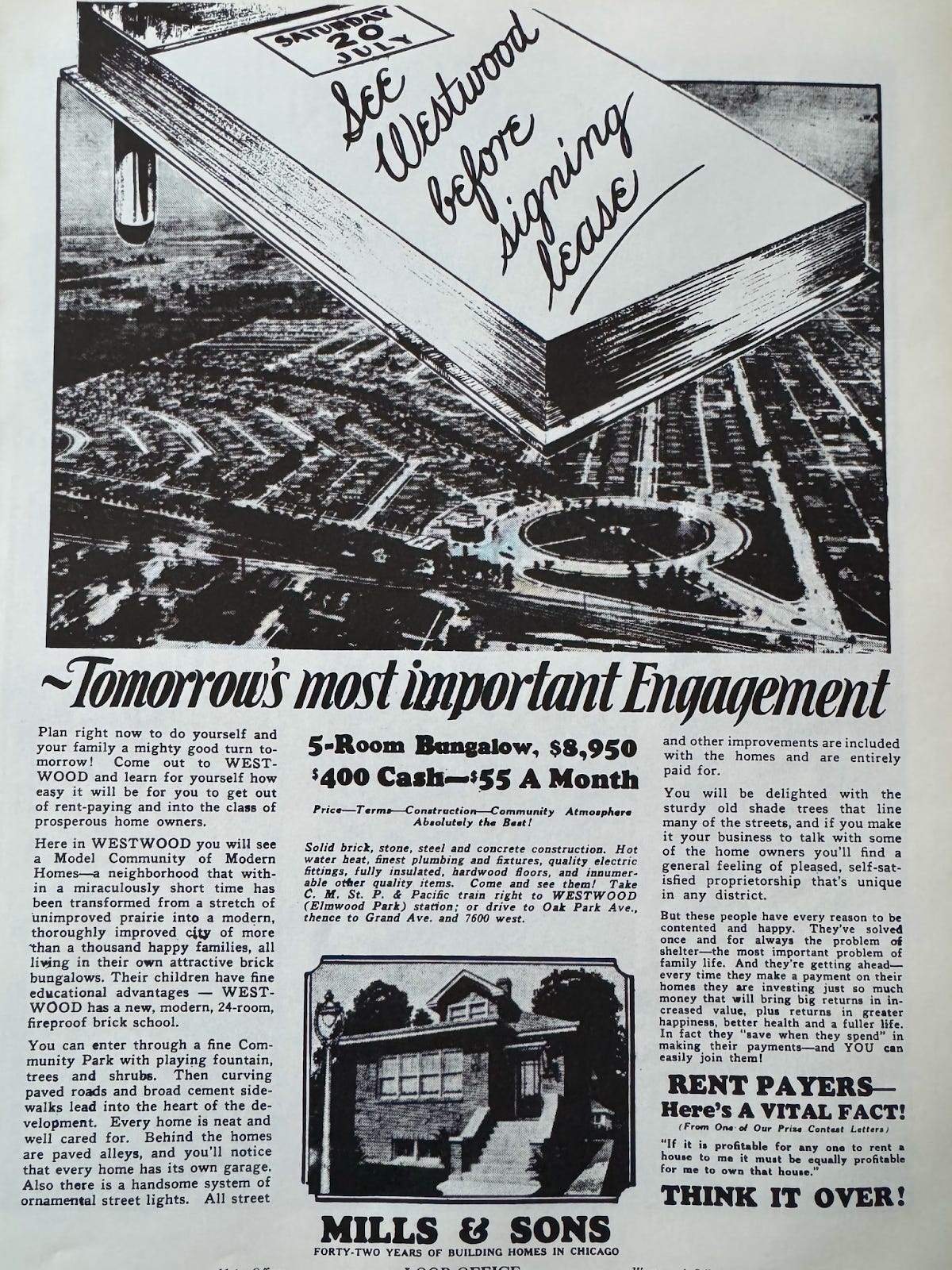
In 1926, Mills, a developer, purchased 245 acres in the northwest corner of Elmwood Park and launched the Westwood subdivision, a master planned neighborhood inspired by a spoke wheel street layout that he had seen in California.
The scale of the project was enormous. His company Mills & Sons announced a $25 million plan, which included more than 1,300 brick bungalows and 146 commercial (business) lots arranged around a central park (what is now commonly referred to as the ‘Circle’).
Homes sold for about $8,900, and with the railroad across the street, Westwood quickly attracted families looking for a practical long-lasting home with an easy commute.
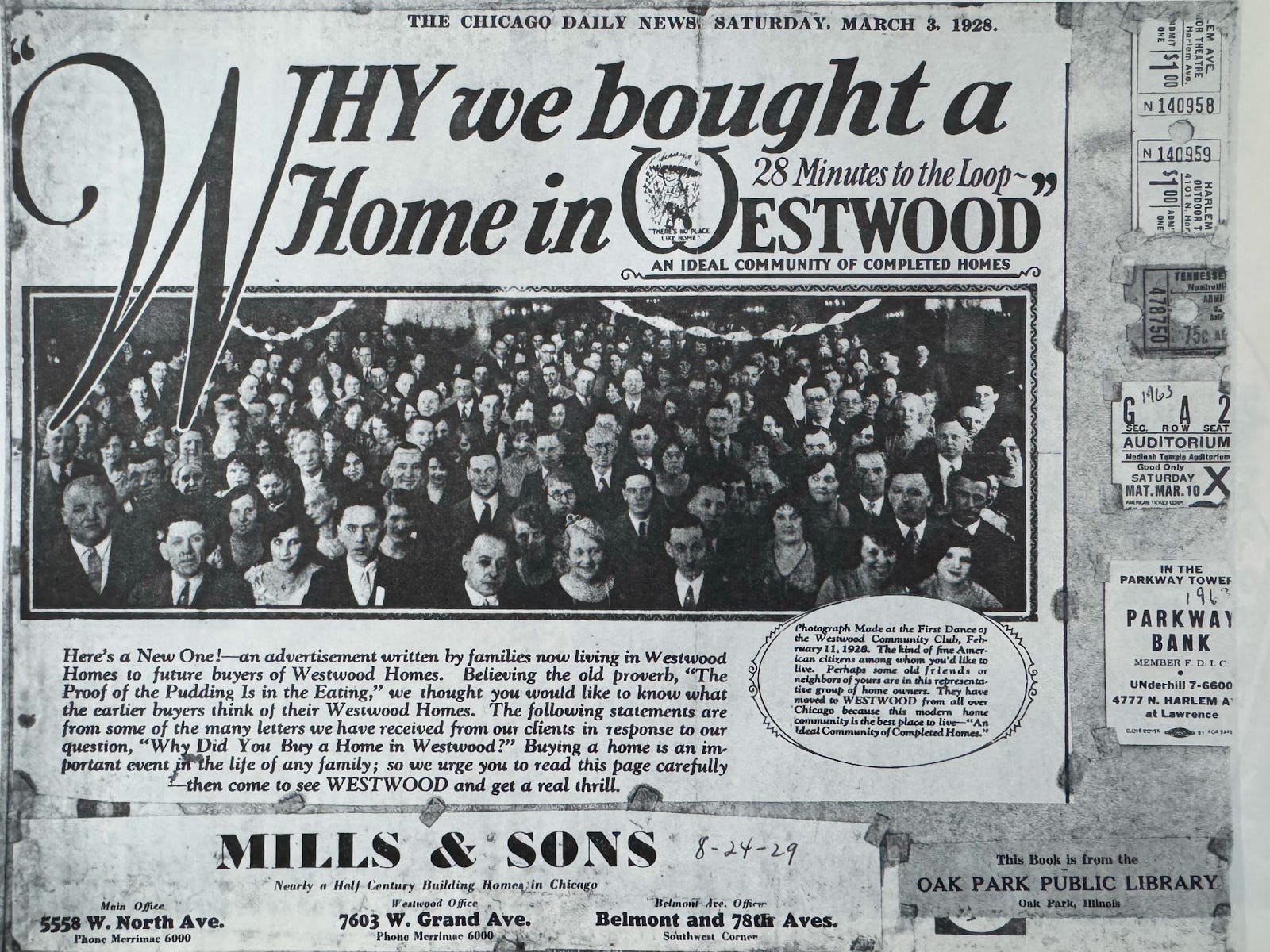
Westwood was not marketed as just any old subdivision. It was sold as a fully formed community.
Advertisements promised “broad cement streets,” landscaped yards, and a central park with “playing fountains.” Families already living there were featured in newspaper spreads describing the neighborhood as friendly, prosperous, and safe.
One 1928 ad announced that Westwood was just “28 minutes to the Loop.” Another emphasized that Westwood had its own brand-new 24-room fireproof school, community clubs, and what they called a “general feeling of prosperity and proprietorship.”
However, what makes these houses truly stand out is the style, the materials, the decorative details. That’s why the Mills bungalows are often described as among the few, or possibly only, “Sullivanesque bungalows” in the Chicago suburbs.
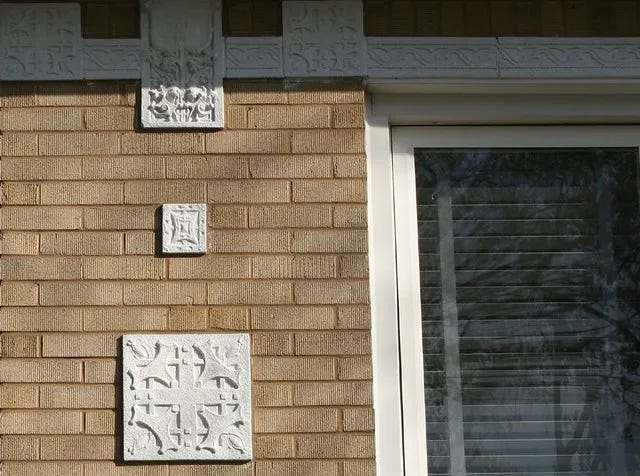
The decorative terra cotta trim, stock ornament supplied by Midland Terra Cotta Company (located at 105 W. Monroe in the Loop), gave these bungalows their signature look. These embellishments were used to accent window surrounds, porch columns, arched basement windows, and large expanses of brick wall.
The first thing most people notice is the front bay, usually square, polygonal, filled with grouped casement or double-hung windows. This wasn’t just decorative. It also helped sunlight brighten up the front room, which served as the heart of the home. Depending on the model, the bay might be topped with a small front gable or a low hipped roof.
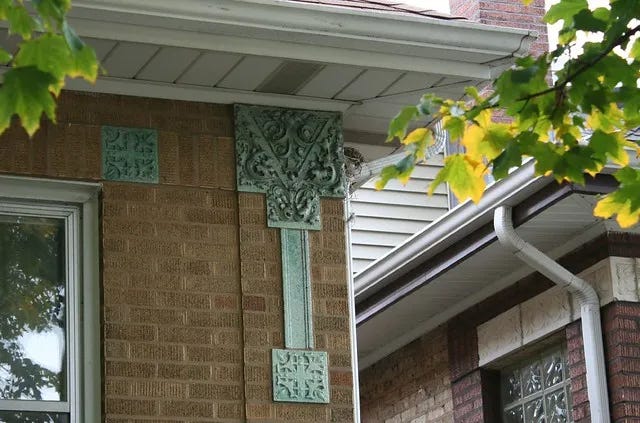
The brick is another defining feature. Most Mills bungalows are built from Chicago face brick, a dense clay fired material known for its durability and color variation. On some homes, you’ll see tapestry brick, textured, or “pulled” brick that creates a very unique look.
Mills alternated brick colors from house to house so that entire blocks felt coordinated without looking identical.
A typical Mills bungalow was marketed as a five-room home, usually with two bedrooms, a living room, dining room, and kitchen, full basement, and an attic that could be finished later.
Many listings highlighted solid construction (brick, stone, steel, and concrete), hardwood floors, tile baths, and modern plumbing and heating systems. Even garages were included.A 12-foot by 20-foot one-car garage was standard— a major selling point in 1928.
The Mills bungalows were more than bare bones starter homes. They were marketed as complete, fully serviced houses with paved streets, alleys, underground utilities, fencing, landscaping, and even an ornamental street-lighting system built in from day one.
Despite all the repetition, Mills was smart about variety. He rotated floor plans, alternated roof shapes, and shifted window arrangements enough to keep the neighborhood visually interesting but still unified. It’s why Westwood doesn’t feel cookie-cutter..
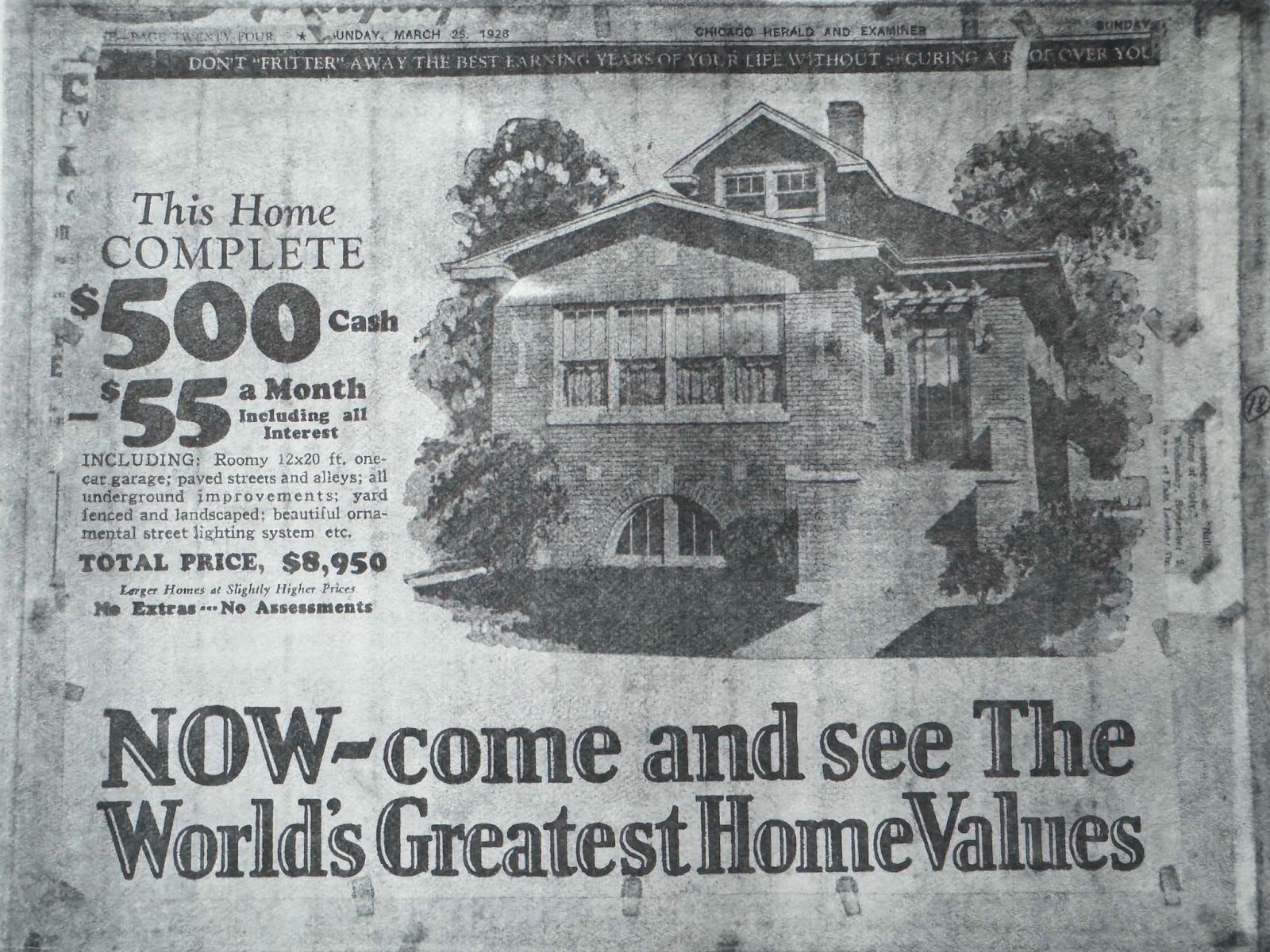
The bungalows were intentionally priced to compete with renting. Ads say that for $500 down and $55 a month, including interest, a family could own a brand-new brick home for about the same cost that many were already paying in rent.
Another ad offered a $400 down payment option, and Mills & Sons reminded buyers that rent was “profitable for the landlord.” The company positioned homeownership as a straightforward path to stability and independence.
Elmwood Park’s concentration of John Mills bungalows is unusually large and unusually intact. Very few suburbs have a neighborhood this cohesive, historically significant, and architecturally distinctive.
If the area was recognized (even informally) as a historic or heritage district, homeowners would potentially gain access to preservation guidance, grants, tax incentives, and the type of neighborhood stability that actually raises property values.
These bungalows are more than relics of a bygone era. They’re a living reminder of a moment when a single developer and thousands of hopeful families reshaped Elmwood Park with craftsmanship and brick that was built to outlast all of us.
If we take care of this architecture, the bungalows will tell that story for another hundred years.
***
Sources:
“Elmwood Park’s Sullivanesque Bungalows,” Chicago Sojourn (2012)
Village of Elmwood Park 1914-1989: Diamond Jubilee
“Elmwood Park: Images of America” by Kenneth J. Knack, Arcadia Publishing
Historic American Buildings Survey (HABS) Illinois Records, related to John Mills & Sons
Cook County Property Records / Historical Maps
Chicago Architecture Center
Love our bungalows, and love this piece 🥰 if only we could get those prices 🤣
Maybe lm wrong but. Unless these homes have had major remodeling done… they all are approaching the 100 year old mark. There is one for sale on my block that took almost 18 months to sell and another year to remodel. It’s dropped in price twice since the almost 600 k original asking price. There comes a time that some things are not worth the price because someone says . They Are Special… l wish they had the same feeling with the land Culver’s is on now. I can’t believe how muck trash ends up on 76th Ave from half eaten item tossed from a moving car or the amount of traffic waiting to get off Grand Ave to get to their drive-thru. I m glad the town is landlocked and sometimes you “have” to tear down something old from something new… but whatever way you go.. there will always be a 50/50 split on what sense it made..